In the corner office of McKinsey & Company’s headquarters, Tunde Birsham, the managing partner, glanced at his diary as he toyed with a triple espresso.
An appointment in his calendar said, “Special Client – 6:00 AM.” No further details. Usually only the cleaning staff and overcaffeinated consultants perfecting slide decks worked at this time.
Tunde gazed out the floor to ceiling window as London woke, the Thames below snaking like a silver ribbon in the dim light.
Someone was already in the leather client chair opposite his own, sitting calmly, hands steepled, backlit by the grey dawn. Tunde nearly dropped his espresso. He hadn’t heard the visitor come in.
Tunde cleared his throat, tugged his suit jacket into place and tried to regain his composure.
“Good morning,” voice steady from years of boardroom battles. “I’m Tunde – Tunde Birsham, Managing Partner. I apologize, I wasn’t aware anyone had come in.”
The visitor inclined his head. “Good morning, Tunde. Thank you for seeing me at such an early hour.”
His voice was low and warm, carrying a resonance that made the hairs on Tunde’s arms stand up.
The man was unassuming – silver hair, kindly eyes, an elegant suit that somehow looked both old fashioned and immaculately tailored.
On the lapel was a simple pin of a dove encircled by a thin gold ring. Not a logo Tunde recognized.
Possibly a family office? A religious organization? The meeting request had come through the firm’s global priority system, marked Confidential and Top Priority.
Tunde had assumed it was a VIP client seeking discreet counsel. Oil sheikh? Tech billionaire with a god complex?
He’d dealt with plenty of those. But something about this visitor was different. Preternaturally calm, as if the stranger had all the time in the world.
He realized he hadn’t caught a name. The calendar invite had simply said “Special Client”.
Tunde managed a polite smile. “Of course. I’m at your service. How can I help, Mr…?”
The visitor gave a gentle smile. “Well, I have many names. But if it makes this easier, you may call me… God.”
Tunde blinked, then let out a nervous chuckle, searching his client’s face for the joke.
The man looked back serenely. Silence filled the room for what seemed like ages.
The city’s first rays of sun peeked over the horizon, casting a halo of light around the stranger’s silhouette.
Tunde felt a sudden need to sit down. God? Perhaps he misheard. Or perhaps this was a code name? Corporations often use project codenames – Project Zeus, Project Athena, that sort of thing.
Maybe this was a high level government project with codename “GOD” (maybe something like “Global Operations Division”). Yes, that must be it.
Steady on, he told himself. He lowered himself into his chair. “Pardon me, did you say God?”
Tunde decided to play along, at least until he could discern the client’s true identity or purpose. High paying clients were sometimes eccentric - he once advised a Fortune 500 CEO who insisted on being called “Iron Man” in meetings.
If this gentleman wanted to be called God… well, Tunde could entertain it.
Tunde: “Alright, God it is. Before we begin - standard diligence if I may. If you are who you imply, proof?”
Visitor: “Certainly. You keep your formative frameworks in threes: structure, insight, influence. You don’t like blue ink - only green. Your first client slide used five fonts, a choice you’ve repented for annually.
At 03:17 on 14 May 2008, in University College Hospital London, you whispered, ‘If she pulls through, I’ll spend my career serving well, not merely billing well.’ She did. You have.”
The room stills. Tunde doesn’t look surprised but suddenly felt seen.
“Not bad. Anything textual? Something any scholar could not simply rehearse?”
Visitor: “Two footnotes you never cite, but you know:
- When Job demands answers, I reply not with a memo but with a tour of contingency - whales, weather, star maps, because context beats conclusions.
- The Throne Verse you love for its poise? You underline the line on sleepless guardianship, but skip the harder clause: that knowledge is given only by My will - consulting’s ultimate scoping statement.”
Tunde smiled and took a deep breath. “Understood. Let’s start. ”
Visitor: “Excellent. For this engagement, call me what you like. Ancient of Days is accurate, but in London I rather enjoy
‘Original Founder’. Shall we proceed as peers?”
“Alright, ‘God’. What brings you to McKinsey this morning?” he asked, injecting a light tone, as if humouring a joke.
God folded his hands. “I have a problem your firm can help me solve.”
Straightforward, client like. Tunde nodded slowly. Every problem has a solution – the McKinsey mantra.
God’s eyes seemed to glimmer with ancient weariness. “The situation,” he began, “is the world. The human world to be precise. It’s in bad shape.” He gestured vaguely toward the window, where London started humming with early traffic.
Tunde thought he’d mis heard. The world? He glanced at his notepad. It’s usually always “market share” or “organizational restructuring.”
Perhaps this was a metaphor. Maybe “the World” was the name of a multinational conglomerate.
He decided to probe. “When you say ‘the human world,’ do you mean a particular organization or… more broadly?”
“Broadly,” God replied. “I mean humanity as a whole. Homo sapiens. My grand project of civilization.”
He smiled kindly. “I’m concerned about its direction.”
“You have existential risks multiplying: climate destabilization, a political system in the United States that’s resembles a reality show scripted by a tired Greek tragedian and the rise of superintelligent AI that may or may not decide humans are simply the planet’s least efficient API.”
This client was either a visionary with a grandiose way of speaking or… possibly exactly who he said he was.
Tunde’s rational mind struggled with the latter. The possibility hung in the back of his thoughts like a quiet, glowing sign: What if…?
His assistant entered with two cappuccinos. God cradled the cup with both hands, inhaling the aroma.
“Ah, free will and caffeine – two things I’ve given humanity they seldom use wisely,” he mused cryptically before taking a sip.
That was an odd thing to say. He’s really in character. Regaining his professional demeanour, Tunde set down his cup. “So, you’re concerned about humanity’s direction. Could you elaborate on the core issues as you see them?”.
“Over the millennia, I see that humans, given intelligence and free will, repeatedly become self destructive despite knowing better.
You war over trivial differences, exploit Earth’s resources beyond what your own scientists warn is unsustainable and devise economic systems that produce great wealth, but concentrated amongst a very few, leaving hundreds of millions in abject despair.
You create technologies beyond imagination, only to turn them into weapons or tools of either destruction or distraction.
In short, the world I intended as a garden for curiosity and compassion has become…” he paused, “chaotic.”
“We also have spiritual entropy” God said, “religion was meant to cultivate compassion, discipline and unity but humans now weaponize it.
Half the world clings to dogma, the other half rejecting meaning altogether and a few million people worship billionaire influencers who sell protein powder and questionable financial advice.”
Tunde wrote:
- Loss of shared purpose
- Fanaticism on one end, nihilism on the other
- Spiritual disorientation
God gestured to the financial district below.
“You built an economic system dependent on infinite growth in a finite world, i.e. the planet is a business model you assume you can scale indefinitely, ignoring the fact that even unicorns occasionally run out of pasture.”
God sighed. “How did quarterly earnings replace stewardship?”
God folded his hands. “Humans are, evolutionarily speaking, Paleolithic minds running on 21st century bandwidth.”
Tunde added another list - Economics: Growth Without Wisdom
- Climate risk
- Inequality spikes
- Short termism baked into incentives
Tunde scribbled, heart pounding. This was either the greatest acting performance or the truth. He decided to test him with a specific. “You mention unsustainable resource use. Are you referring to climate change?”
Tunde scribbled, heart pounding. This was either the greatest acting performance or the truth. He decided to test him with a specific. “You mention unsustainable resource use. Are you referring to climate change?”
God gave a gentle smile. “Among other things, yes – the warming of the atmosphere you were warned about decades ago yet have collectively done far too little to halt.
You’d think a species that can land on the Moon could reduce carbon emissions. But here we are in 2026 and they continue to rise. It’s one of many examples of humanity’s self destructive urges.”
Tunde’s pen hovered as the words triggered a memory - the phrase “Thanatos” came to mind: Freud’s so called death drive, the theory that living beings harbour an unconscious wish for self destruction.
God continued, reading Tunde’s thoughts. “Yes, some psychologists have named it Thanatos – an instinctual drive towards destruction and chaos.
Philosophers and theologians have other names for it. In religious terms, one might speak of sin or the fallibility of man. Economists note it in the way long term collective good is sacrificed for short term individual gain – a kind of built in shortsightedness.”
He sighed. “The world’s biggest problems, all rooted in human folly. As you succinctly put it: idiosyncrasies, self destructive urges. A rather futile cycle, it seems.”
Tunde listed the psychological issues:
- Tribalism – “The ancient instinct to sort, label and resent.”
- Denial – “Normalcy bias so strong we ignore rising seas, rising temperatures and rising political extremism, assuming someone else will handle it.”
- Dopamine addiction – “Our attention economy is a brilliant but catastrophic development. Humans were not built for infinite scroll.”
- The Death Drive – “We often choose destruction simply because it feels easier than cooperation.”
Tunde felt a small chill. His visitor had just seamlessly woven psychology, theology and economics together.
Who is this man, he wondered for the dozenth time.
If it was a role, it was brilliantly executed and terrifyingly insightful. If it was real… well, Tunde wasn’t prepared for such a client.
Tunde recapped to ensure understanding: “So, if I may summarize, you’re concerned that humanity is exhibiting patterns of self destruction – in warfare, in environmental neglect, in economic and social systems – and that these idiosyncrasies of the human world are threatening its future.”
“Well,” Tunde said, “McKinsey prides itself on tackling tough challenges. But I admit, saving humanity from itself would be a new type of engagement.”
God arched an eyebrow. “That’s why I’m here. I’d like to hire McKinsey & Company to consult on how to fix the world. Consider this a consultation for an entire planet.”
Tunde looked into those steady, ancient eyes and felt something shift in his understanding.
What if this was genuine? The proposition was so grandiose it looped back into plausible. If one were God and wanted to spur change without violating free will, why not employ a human firm known for analytical prowess and influence? It was at once ridiculous and strangely logical.
At the very least, Tunde reasoned, going along with the premise couldn’t hurt. If it was a prank or delusion, he could humour it until clarity emerged.
He drew a line under his notes. “Alright. Suppose we take this engagement. We’d need to clarify the objectives. Fix the world is a rather broad mandate. Could we break it down? For instance, what do you see as the key issues we need to address first?”
God’s face grew serious. “I believe you call them workstreams. Let’s outline three major domains: theological, economic, and psychological. These cover the spiritual confusion, the systemic worldly problems and the individual human behaviour issues, respectively.”
He counted on his fingers: “
- Theology – humans have lost a unifying sense of purpose or morality; even religion often divides them instead of guiding them.
- Economics – your systems of production and consumption encourage short term gains and externalize costs in destructive ways.
- Psychology – the cognitive biases and emotional tribalism of humans lead them to hurt each other and themselves, even when logic would suggest cooperation. These three capture much of the dysfunction.”
Tunde scribbled the triad on the whiteboard
He asked, “And the ultimate goal? Let’s define success. Are we aiming for world peace? Sustainable planetary management? Enlightened society? All of the above?”
God steepled his fingers thoughtfully. “Success would be humanity not destroying itself – and perhaps even thriving in harmony with the world and each other.
Think of it as moving from the brink of self inflicted apocalypse to a path of sustainable, enlightened existence. In other words, to solve war, poverty and environmental collapse and usher in an era of, dare I say, heaven on earth.”
A silence followed his words. Heaven on earth. Right. No pressure. Tunde joked weakly, “As consultants, we usually caution clients that we’re advisers, not miracle workers.”
God’s eyes sparkled with mischief. “Why do you think I came to you? I handle miracles; I need you to handle the advisory part.”
“To be clear, I don’t expect you to do it alone. But you have a certain expertise in strategy and management that could complement, shall we say, my domain knowledge about humanity.”
Tunde found himself smiling, the absurdity infectiously charming. “Alright. Suppose we accept the engagement. The next steps are data gathering and diagnostics. Perhaps we should discuss each domain – theology, economics, psychology – in turn, identify the core problems and potential solutions or at least approaches.” He paused, then added, “I hope you don’t mind if I take the lead structuring our discussion. Old habits.”
God gestured for him to proceed. “By all means, lead on. I’m curious to see how you tackle the human condition.”
On the board Tunde wrote in neat block letters: The World’s Biggest Problems. Underneath, he made three columns titled Theology, Economics, Psychology.
He stepped back. “Let’s start with Theology – by which I interpret broadly as meaning, the spiritual or moral framework of humanity.”
God rose and joined him at the board, hands clasped behind his back, observing. In the morning light, his silver hair gave him a sage like aura. Tunde suddenly felt self conscious and tried not to find it disconcerting that he was effectively brainstorming with the Almighty.
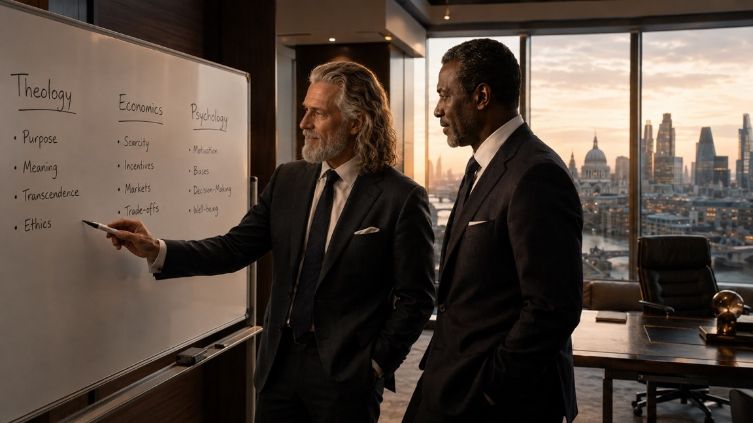
Tunde began, “Theological issues: You said humans have lost a unifying purpose or moral guide. Could you expand on that? From your perspective, what’s gone wrong with religion or spirituality in today’s world?”
God sighed gently. “Religion was meant to be a path to understanding fundamental truths – compassion, humility, love for one’s neighbour.
Over time, many religions became institutions and often tribal identifiers and instead of uniting, they sometimes divide.
I see wars fought in My name by people who, ironically, seem to have ignored most of what I tried to teach through prophets and sages.”
He shook his head. “Theology has become either dogmatic or irrelevant to many. In some quarters there’s fanaticism – an insistence that one creed must dominate. In others, there’s emptiness – a materialism that rejects any higher values. Neither extreme bodes well.”
Tunde nodded. “On one side, extremist zeal leads to conflict; on the other side, nihilistic secularism or consumerism filling the void.” He jotted fanaticism under Theology column, and loss of meaning as well.
“It’s like humanity has spiritual whiplash: some cling to dogmas, others to dollars. Hard to get alignment on common values for the common good.”
God looked out the window as if seeing millennia of human history at once. “In mythological terms, I sometimes think of the Tower of Babel – humans once united, but then splintered by language and understanding . Except now it’s ideological Babel. Everyone’s speaking past each other, no shared narrative of what life is about.”
“So a key problem is: no shared story or purpose. People either fight over differing beliefs or, lacking belief, fall into cynicism and self-interest.”
He scribbled a summary: Fragmented moral vision. “Potential solution directions… Perhaps a new narrative or a set of universal values that could be widely accepted? That’s tricky. Historically, even when there were dominant narratives, they excluded some people.”
God’s eyes glinted. “Well, perhaps McKinsey can help craft a mission statement for humanity,” he said lightly. “Your clients all love mission statements, don’t they?”
Tunde laughed despite himself. “True. We’d need something genuinely inspirational and actionable.”
“Let’s park that for now,” Tunde said, “we’ll return after looking at the other areas.” He moved to the next column. “Economics.”
“Ah, where to begin,” God murmured. “This one is glaringly obvious from up, well, from my perspective. You’ve built impressive economies, created immense wealth, but at a terrible cost.
The planet’s ecosystems are treated as an infinite supply store, an infinite rubbish dump and the fruits of economic growth are so unevenly distributed that a small percentage of people live in excess while many others struggle with nothing.”
As he spoke, Tunde felt an uncomfortable twinge. McKinsey had advised many a Fortune 500 company on profit maximization and efficiency. Some critics accused such firms of contributing to inequality or cold cost-cutting that hurt workers.
The managing partner in him bristled defensively, but the human in him knew the critique wasn’t unfounded. He jotted Climate Change, Resource depletion, Inequality under Economics. “It’s true. We face what an ecologist would call the Tragedy of the Commons – individuals and companies pursuing their self-interest overuse shared resources, leading to collective ruin. Classic conflict between individual and collective rationality.”
God pointed at Tunde’s note about the commons. “Exactly. As one of your encyclopedia entries nicely puts it, the tragedy of the commons highlights the conflict between individual and collective rationality.
Everyone acting to maximize their own gain results in overfishing the seas, polluting the air, overconsuming the forests. I equipped Earth to provide abundantly for all, yet through greed and mismanagement, you’ve managed to manufacture scarcity.”
His voice carried both sadness and a hint of anger. “And then there’s the economic ideology that unlimited growth is good or even possible. A planet is finite; an economy chasing infinite growth is like a snake eating its own tail.”
Tunde was reminded of the Ouroboros symbol, an ancient image of self destruction. Fitting for a conversation on human futility. “You sound like you’ve been reading reports from the Club of Rome or ecological economists.”
God smiled. “Many in power still ignore those warnings. Humans have a habit of believing tomorrow’s problem can be handled tomorrow. As Keynes famously quipped, ‘in the long run we are all dead’ – a line economists use sometimes to shrug off distant consequences. Ironically prescient, given the path humanity is on.”
Tunde noted it. Short termism. “And inequality?” Tunde prompted. “It’s said the richest 0.5% own more than the bottom half combined, and so on. Does that factor in the self destruction equation?”
God nodded. “Extreme inequality? It breeds resentment, instability and waste of human potential. Societies that grow too top heavy eventually topple. History has already shown you.
Great civilizations often collapse from internal corruption or inequality, not just external invasion.
Now, your global elites build rockets and offshore havens while society’s foundations – trust, cohesion, basic welfare, erode.”
Tunde felt a sinking feeling. Humanity undermining itself from within – the theme of this entire conversation.
“Alright,” he said, capping the marker briefly. The whiteboard now had a sombre list under Economics: environmental collapse, climate change, resource exhaustion, inequality, short termism.
“Potential solutions here… Possibly transitioning to a sustainable economy, renewable energy, circular material flows. And addressing inequality – reforms in taxation, maybe a new social contract. Big stuff, but at least conceptually straightforward: use less, share more.”
God chuckled softly. “Conceptually very straightforward indeed. Implementation – not so easy when greed and fear dominate. But yes, we’ll come back to solutions.”
Tunde moved to the third column: Psychology. “Now, the human psyche and behaviour. You mentioned cognitive biases and tribalism. Let’s flesh that out.”
God walked over, hands clasped behind his back as if lecturing gently. “Human minds are remarkable – reasoning, empathy and imagination yet so often ruled by primitive impulses.
Fear, anger, the fight or flight instinct – they had their place in early survival, but now often misused.
A slight difference in opinion and people mentally sort each other into friend or foe. Minor discomforts and they deny inconvenient truths. A tendency towards denial and wishful thinking that prevents humanity addressing the big problems.”
Tunde said thoughtfully, “Denial, yes. Psychologists call it normalcy bias – people underestimate the possibility of disaster and carry on as if everything’s fine.
He wrote Denial (Normalcy bias) on the board. “This explains a lot – from how some people ignored pandemic warnings to how we’re slow on climate change. The house is on fire, but most assume someone else will douse the flames or that the smoke is just the new normal.”
God smiled ruefully. “Indeed. The normalcy bias causes many to disbelieve or minimize threat warnings . In biblical terms, it’s like in the days of Noah – people were eating, drinking, marrying, oblivious to the coming flood until it was upon them.
I promised never to flood the earth again, but I never said anything about you flooding yourselves.” He sighed. “What can I say? Free will is as much a burden as a gift. Humans often choose the comfortable lie over the uncomfortable truth.”
Tunde marked down Comforting Lies. “Then there’s tribalism – identifying with an in group and dehumanizing out groups. We see resurgent nationalism, sectarianism. Social media, ironically, has amplified echo chambers and division instead of broadening understanding.”
“Ah yes,” God said, almost wearily. “That which was meant to connect you – the internet – often ends up isolating and polarizing you. The devil works in mysterious ways, but these days I suspect he just exploits your algorithms.”
A thought suddenly crossed Tunde’s mind. “So why then did you create the Kardashians?”
God laughed. “Ah yes, the Kardashians. They’re the perfect blend of spectacle and distraction.
Every age needs its distractions. In ancient times, it was gladiator games. Now, it’s reality TV. Plus, they boost the economy. Think of all the industries thriving because of them – plastic surgery, fashion, social media.
Just between us, I’m a little addicted to their shows”.
Embarrassed, Tunde tried to move on. “So under Psychology, “we have denial/normalcy bias, tribalism, confirmation bias – people only accepting what fits their preconceptions and maybe what we might call the ego problem: pride, unwillingness to admit mistakes.
Also, aggression and the ease with which fear turns to hatred.” He jotted these. “It’s basically the whole human condition greatest hits. From the Freudian death drive to the seven deadly sins.”
God nodded solemnly. “Pride, envy, greed, wrath… they do make their rounds. It’s funny how textbook it is. You could practically check off each sin watching an hour of cable news or a single political rally.”
He paused, then added softly, “I’m not here just to scold humanity though. I know your species also has love, creativity, courage. Otherwise I wouldn’t bother with an intervention at all. The hope, and I use that word carefully, is that those positive traits can be rallied to overcome the darker impulses.”
Tunde glanced at the board, crowded with problems. Theology: fanaticism and nihilism. Economics: exploitation and inequality. Psychology: denial and division. It was daunting, to say the least. “This is the clearest problem statement of the world’s futility I’ve ever seen,” he said quietly. “Even though we all live these issues daily, to see them itemized is overwhelming.”
He capped the marker. “No wonder you’re asking for help, ah, Sir.” He still balked at directly saying “God” to the man’s face. Calling a client “sir” was second nature, and it seemed ironically appropriate.
God seemed not to mind. He was studying the board with a thoughtful tilt of the head. “It’s a fine summary. ‘The world’s biggest problems,’ indeed.” He gave a slight smile. “If nothing else, Tunde, you’ve impressed me with your clear thinking.”
Tunde chuckled and ran a hand through his hair. “Let’s hope I earn your gratitude by finding some solutions. Diagnosing is one thing; prescribing the cure is another.”
He felt the weight of the task. Where to even begin? Had he just got a laundry list of symptoms and not understood the root causes? Was there a deeper single thread he hadn’t grasped?
Many great minds over centuries had proposed ideas to solve these ills – from religious reformers to political revolutionaries, with mixed results.
What could a consulting approach offer that hadn’t been tried?
He turned to God, who was now leaning against the windowsill, the city now fully illuminated behind him. “We’ve broken things into categories, but perhaps there’s an underlying human idiosyncrasy tying them together, something fundamental about people that leads to these self destructive urges.”
God’s expression grew pensive. “Many have tried to name that root. Some call it ignorance. Some call it original sin. Some say evolutionary mismatch – that humans are Paleolithic emotions with godlike tech. Perhaps it’s all of those. Personally, I think a lot boils down to fear. Fear and its offshoot, the hunger for control.”
He began to pace slowly, hands gesturing as he talked. “Fear of death, fear of the other, fear of not having enough – these drive humans to hoard wealth, to dominate others, to cling to dogmas.
“The irony is, in doing so they create the very dangers they fear. Fear of death leads to stockpiling weapons that could annihilate all life.
Fear of scarcity leads to greed that impoverishes many and wrecks the environment, ensuring scarcity.
Fear of the other leads to hostility that begets war, making the world more dangerous for everyone.”
Struck by the simple clarity of that analysis. Tunde knew that most destructive behaviour is rooted in fear or insecurity at some level. The drive to appear strong, the drive to accumulate – all fear based.
“So if humanity could collectively overcome fear?” he ventured.
“They’d be a lot closer to what I hoped they’d be,” God finished. “Which is curious, because so many of your religions – including those venerating Me – teach ‘fear not.’ Angels in scripture always start with ‘Do not be afraid.’ Yet fear reigns in human hearts. It’s a kind of perpetual panic, sometimes quiet, sometimes overt.”
Tunde started thinking about modern society - how even amid relative safety, people self sabotage by manufacturing crises or anxiety, with 24/7 news cycles, social media outrage monetizing fearmongering.
“We repeat mistakes,” Tunde added, “from our inability to learn from the past. We know the outcomes of unchecked hubris or inequality or arms races from history, and yet we walk right into them again, believing this time will be different.”
God laughed softly. “Ecclesiastes 1:9 – What has been, will be again”. Perhaps that’s an evolutionary feature – optimism bias, thinking we won’t fail where others failed. That can drive progress, but also folly.”
I’ve watched every empire think it’s eternal, every bubble think it’ll never burst, every generation think it’s wiser than the last and almost all end up repeating familiar patterns. As the saying goes, the one thing we learn from history is that we learn nothing from history.”
Tunde imagined an opening line in a magazine piece: “Even the world’s top consulting firm couldn’t solve humanity’s drive for self sabotage.” Dry, wry, rather sad. Even God’s current consultant looked rather stumped.
Tunde took a breath. “So ultimately, humanity is at war with itself, with its own nature. And even in trying to solve problems, we often create new ones.”
He coughed into his hand and looked at God. “Any attempt we make at a ‘fix’ – won’t it run into this fundamental issue?
Say for example, we recommended a global initiative to cut carbon emissions drastically. Won’t the economic and political systems, driven by fear and greed, block it or water it down?
Or what if we proposed a unifying set of values? Won’t different cultures react with fear if they see it as an attempt to dominate or erase their identity?”
God nodded grimly. “That is the crux of it. It’s like performing open heart surgery on a patient who’s also resisting the doctors.”
He gave Tunde a knowing look. “I never said it would be easy. If it were easy, I wouldn’t need to hire consultants.
I could snap my fingers but that defeats the purpose of humans growing into wisdom on their own. They have to choose it.”
There it was, Tunde thought: the prime directive, so to speak. God won’t just mind control everyone to be good (free will clause), nor unleash another biblical apocalypse (that would rather moot the exercise).
He wants a solution through human agency, albeit nudged by some divine impetus, hence this engagement.
Tunde smiled at the irony. McKinsey & Co, quietly contracted by God to save the world. The ultimate confidential client. Tunde thought about writing a book about this but no one would believe him. It was absurd.
And yet, looking at the earnest, concerned face of the man claiming to be God, Tunde didn’t sense madness. If anything, the stranger in his office seemed like the sanest being he’d ever met.
Tunde glanced at his watch – 7:15 a.m. already.
Outside, London’s streets were busy now; oblivious to God and a consultant plotting its salvation.
He wondered about alerting colleagues, but how? Assemble team: God project. NDA required.
Tunde said. “In the past, humanity has made progress addressing these issues, or when they failed spectacularly – to glean insight.” He wondered whether God had a few case studies of divine interventions up his sleeve to showcase “what good looks like”.
God leaned against the table, one leg crossed over the other. “There have been moments. The end of great wars brought periods of reflection and institution-building – the United Nations, human rights charters, environmental movements, all showing what’s possible with understanding and cooperation.”
He paused, then said more quietly, “And I also did attempt to guide more directly.
Remember my stories sending prophets or enlightened figures. Moses, Mohammed, Bhudda? Jesus, teaching love and mercy?
Look what happened. Within a few centuries, His followers were wielding swords in His name. And so on with others. The message gets taken over by power structures.”
“So direct divine messaging hasn’t quite solved it,” Tunde summarized diplomatically. “What about less direct, say, shaping events? The flood? That was a very drastic intervention according to scripture.” He immediately wondered if mentioning the flood might offend, but God didn’t seem angry.
“That was a long time ago,” God said with a distant look. “I was disappointed in humanity’s violence and thought a reboot might help.
Noah and family were decent folks; I figured a fresh start with them would improve things. It did, for a short while, but soon enough… well, new generations, same habits.
I vowed not to wipe out humanity again – it was clear brute force doesn’t change hearts.
You know what it’s like – similar to a consultant firing half the staff of a company – if the culture itself doesn’t change, dysfunction returns.
Ever since, I’ve avoided overt doomsday interventions. Instead, I’ve hoped humans would learn and mature. I’ve nudged here and there – inspiration to scientists, small miracles, etc. But subtlety has its limits too.”
Tunde felt a strange comfort in how candid and fallible this God sounded. Not the thundering Zeus-like figure of movies, but a weary project lead grappling with intractable issues and admitting prior approaches hadn’t fully worked. It made the situation feel less surreal and more… collaborative.
“What about mythological or allegorical insights?” Tunde mused. “Sometimes ancient myths capture truths. For instance, Pandora’s box – all the evils unleashed into the world and only Hope left trapped inside . Some interpretations say it means that even as evils plague humanity, the mitigating force, hope, remains unreachable, implying life is full of troubles and humans persist with only a futile hope that things will improve . ‘Life is not hopeless, but human beings are hopelessly human,’ as one commentary put it.”
God gave him a keen look. “Hopelessly human… yes. That captures it neatly. They have hope, but don’t know how to realize it. They hope problems will solve themselves or that I’ll magically fix everything. Yet they cling to the very behaviours that create the problems, being human, all too human as Nietzsche said.”
He grinned ruefully. “Though Nietzsche also called hope the most evil of evils because it prolongs man’s torment. A bit dramatic, but I see his point. False hope without action is indeed pernicious.”
Tunde scratched his chin. “Are we at risk of dealing in false hope here? I mean, realistically, can even a divine mandate, executed through a consulting strategy, turn this around? Many would say humans are simply flawed and destined to collapse eventually. From Ozymandias to Atlantis to modern empires – everything falls apart.”
God set his coffee cup down. “I wouldn’t be here if I thought it hopeless,” God said firmly. “Let’s say I’m cautiously hopeful. I’ve seen enough individuals transcend their selfishness, enough communities rally in crises, to believe that given the right push, humanity could pull back from the brink.
And if I’m wrong – well, eternity is long and I have contingency plans.
But I’d rather not scrap this project and start over on another planet. I’m fond of you lot, troublesome as you are.” He offered a warm, sad smile.
A strange swell of emotion rose in Tunde’s chest. The words “I’m fond of you” coming from this client figure felt like both an encouragement and a gentle chastisement, a parent expressing love for a wayward child.
It made him want to live up to that trust and he felt a profound sense of responsibility dawning.
If this was real, he’d essentially been drafted by God to help save the world. If it wasn’t real, then at worst he was humouring a brilliant eccentric and could write it off as a fascinating morning.
Either way… why not try as if it were real?
“Alright,” Tunde said, straightening, “so where does that leave our strategy? We have a broad diagnosis and a motivation to act. We need a plan that addresses fear, encourages learning, and aligns human actions with their long-term survival and flourishing. Perhaps a multi pronged approach: some immediate actions (like immediate risk reduction on urgent threats), and longer term cultural shifts.”
He moved to his desk and opened his laptop, pulling up a blank PowerPoint out of habit. He glanced at God. “I hope you don’t mind if I take notes electronically – I promise I won’t show this to anyone without clearance.”
God chuckled. “By all means. I have no issue with technology; some of your people assume I’m anti tech, but I did endow you with curiosity for a reason. Use whatever tools help.”
Tunde, fingers on keyboard, paused. “If we formulate a plan, how exactly would we implement it? You as… God, presumably have some ways to influence events subtly.
And McKinsey has its network, though I can’t exactly announce ‘We’re on a God given mission.’ What if we operate behind the scenes? Influence governments and CEOs under the radar?”
God tapped his chin. “I see it like this: McKinsey would develop the strategy and perhaps discreetly pitch pieces of it to key stakeholders – world leaders, the UN, NGOs, even grassroots movements as if it were your own idea or a pro bono initiative.
Many of your colleagues wouldn’t know the true origin of the mandate; they’d just be told it’s an internal special project on global sustainability or something.
I can arrange that those in power listen more receptively than usual. Call it a touch of divine favour in opening the right doors.”
He winked. “I can also ensure funding isn’t an issue – maybe an anonymous grant or two in the billions to back the execution.”
Tunde raised his eyebrows. “That certainly helps. Nothing greases wheels like well placed billions.”
He knew of plenty of philanthropic outfits and foundations whereby an infusion of inexplicable cash would hardly be noticed among the ultra rich these days. If a mysterious donor advised by McKinsey started pushing a save the world agenda, people might just accept it.
“However,” God continued, “the key to this is framing. You already have many plans and reports gathering dust. We need something that cuts through apathy and fear. I suspect a bit of showmanship may be necessary.”
Tunde tilted his head. “Showmanship?”
God’s eyes twinkled. “Not to be irreverent, but maybe a Burning Bush 2.0 moment – something awe inspiring yet not destructive, to jolt people’s minds.
Perhaps revealing, at the right time, that I was the client might do it. But then again, folks might either not believe it or turn it into a religious frenzy which we don’t want.”
He sighed. “It’s such a delicate balance: provide evidence of the divine to galvanize goodwill, but not so much that it overrides free reason or spooks people into irrational behaviour.”
Tunde rubbed his temple. This was beyond any change management where you roll out a transformation plan with town hall meetings, training, new incentives… Not with subtle miracles and partial theophanies.
“Well,” he said, “let’s cross that bridge when the plan is ready. For now, let’s outline what McKinsey’s official recommendations would be in a report.”
“First, Immediate Risk Mitigation: Identify the most imminent self destructive scenarios and defuse them. That likely includes nuclear war risks, climate tipping points and generative AI.
For nuclear, maybe some renewed disarmament talks – getting world powers to step back from the brink (there’s been creeping arms race again).
For climate, push emergency decarbonization efforts – perhaps a global agreement stronger than Paris, with enforcement teeth.
And with AI, a global framework with veto powers.”
God nodded. “Yes, avert what could make everything else moot. The threat of sudden annihilation, whether by war, ecological collapse or Ai deciding it doesn’t need humans..”
“Second, Global Cooperative Framework: essentially, improve global governance. We might recommend U.N. reforms or a new coalition that can enforce climate action, coordinate pandemic responses, regulate AI and mediate conflict effectively.
This might mean empowering global institutions beyond current political norms. Perhaps a new Council of Humanity comprised not just of politicians but scientists, ethicists, etc., with some real authority.”
God raised an eyebrow. “A Council of Humanity… interesting. As long as it doesn’t become an oligarchy of technocrats. But since politicians are usually short sighted, perhaps some wise council could be helpful. It reminds me of legends of wise elders or philosopher kings: rare in practice, but we can try.”
“Now’, said Tunde after reflecting for a few seconds. “On Earth’s Sustainability and Leadership,” he paused.
God: “I gave you a masterpiece. Oceans, ecosystems, sunsets over the Serengeti. And yet, humanity is trying very hard to void the warranty.”
The partner responded thoughtfully. “But we’re seeing cross sector momentum. ESG, circular economy models, climate innovation. But we need moral clarity to match the metrics.”
God smiled. “Agreed. Perhaps fewer reality TV stars in powerful positions.”
“Third, Economic Reformation: We propose shifting incentives – carbon taxes, wealth taxes, investment in sustainable infrastructure, a move away from GDP as sole measure towards quality of life metrics.
We need to rethink wealth redistribution mechanisms or at least universal basic income to align the economy with long term planetary stewardship and human well being, not just quarterly profits.”
“Ambitious,” God remarked. “I like it. Some will howl ‘socialism’ or ‘utopianism,’ but if framed as survival and common sense, maybe they’ll come around. You may quote me: ‘Man does not live by bread alone’.
Tunde typed and chuckled. “Fourth, Education and Mindset Shift: This addresses the psychological element. We need massive investments in education to teach critical thinking, empathy, global perspective.
A curriculum of Earth Citizenship, almost. Also, utilize media and influencers to promote cooperation and debunk tribal fears.
Maybe a global campaign akin to the Apollo program, but instead of going to the moon, the mission is ‘Saving Spaceship Earth.’ Rally people around a positive vision, something inspiring that can compete with the allure of nationalist or extremist narratives.”
God clapped softly. “Spaceship Earth – I’ve heard that metaphor. It’s apt. You’d better start acting like it. Yes, a shared positive project can do wonders. Humans do seem to unite against common challenges when they recognize them.
Perhaps framing climate action as a war effort of sorts – but a war on entropy or on our own folly, rather than each other. In World War II, nations achieved incredible economic mobilization; if that could be done in peace for climate and poverty, imagine.”
Tunde nodded vigorously, feeling momentum. “Fifth, Spiritual Reconciliation: Perhaps an unusual recommendation for McKinsey, but given the theology aspect… We could convene an Interfaith and Humanist Council to articulate a common set of core values.
Something everyone from an imam to an atheist scientist could agree on – like the dignity of life, the Golden Rule, stewardship of the Earth. It might be somewhat symbolic, but symbols matter. A declaration or charter of universally accepted principles could be the moral backbone to accompany the practical measures.”
A cloud crossed Tunde’s mind. “What about atheists? How should they be treated?”
God: “Ah, the atheists. They’re like the customers who refuse to believe the company exists yet still use the products. Think about Richard Dawkins, I’ve always appreciated his passion. I like to think of his book, ‘The God Delusion’ as the divine version of tough love. He’s a persistent QA engineer for metaphysics. Valuable, occasionally noisy, always welcome He keeps the conversation interesting.”
Tunde laughed. “You’re not offended by them?”
God: “Not at all. Everyone is entitled to their journey. Besides, atheists often seek truth, and I’ve got all the time in the universe for that. Eventually, they might realize the search for truth often leads them right back to me.”
The managing partner added, “What about other faiths? Won’t they be sceptical about a Christian led approach?
Original Founder: “Skepticism is just reverence wearing lab goggles. Invite it in.”
The visitor’s face lit up subtly. “The idea of all faiths and philosophies finding common ground will be beautiful.
They might not all agree on my nature, but they can agree on the basics of right and wrong and our duty to each other. In essence, remind humanity we’re one family. If you’ll allow a fatherly perspective: siblings have squabbled far too long, it’s time they recognize each other.”
He typed up these five broad recommendations, each with sub bullets, his consultant mind effortlessly flowing now that the outline was clear. The plan was shaping up bold and comprehensive – it certainly didn’t lack ambition. It was borderline quixotic, but as a wise man once said, “if you’re gonna dream, dream big”.
God stepped closer and peered at the laptop screen. “Not bad for an hour’s work, Tunde. You know, some prophets spend 40 days in the desert to come up with a plan; we did it in a morning with espresso.”
As God reviewed the slide deck draft, He commented, “ “You structure ambiguity into clarity rapidly. That’s what I need.”
Tunde laughed. “Well, we have a reputation for fast turnarounds.” He saved the document - it would be awkward if an act of God (literal or figurative) caused a power outage and he lost this miracle plan.
The skeptic in Tunde spoke up: “Even with all this, do you really think humans will execute it? What if, as often happens, initial enthusiasm fades, or narrow interests derail the process?”
God was silent for a moment. He looked at the whiteboard with all the problems, then at the laptop with the shiny solutions. “I won’t lie, Tunde. They might. They probably will in some places. This isn’t something that wraps up neatly by end of quarter. It might take decades, and we might only get partial victories. Humans have a way of muddling through and sometimes that’s enough, sometimes not.
But I believe in giving them a chance. Because the alternative – me unilaterally resetting things or watching in silence, is worse.”
He placed a hand on Tunde’s shoulder. It was a strangely paternal gesture that felt both comforting and galvanizing. “Besides, I have a little more faith in humanity than perhaps they deserve. Call it divine optimism. I’ve seen unexpected goodness too: strangers risking their lives for others, movements for justice blooming against all odds, knowledge triumphing over ignorance in the long arc. Perhaps, with a bit of guidance, that side of humanity can win out.”
Tunde swallowed the lump that suddenly formed in his throat. It’s not every day your client basically says, “I have faith in you.” Coming from this client, it resonated profoundly. He straightened up, feeling a renewed determination.
“Well,” he said, trying to lighten the mood that had grown earnest, “McKinsey’s honour is now on the line too. We love a tough target. Our unofficial motto: ‘We solve the problems no one else can.’ This certainly qualifies.”
God grinned. “I thought your motto was something about ‘enduring relationships with clients?”
Tunde groaned playfully. “That too. I guess you’ll be our client for eternity, talk about a long-term relationship.” They both laughed.
Based on his years of moving from strategy to implementation, Tunde realised he was already thinking beyond this meeting and assembling a team (who could he trust with something so outlandish?) to discreetly initiate steps of the plan.
Tunde closed his laptop. “We can execute. One more question. Will you sign the Statement Of Work?”
Original Founder: “Not I.”
“I beg your pardon?”
God said dryly, “I’m not the client; I’m the cause. Earth is the client.
Humanity is the product owner. You’ll consult them all - governments, communities, platforms, brands.
Bill no one what they cannot afford; charge everyone what their integrity can bear.”
“And Tunde”, said the Original Founder softly, “send your sharpest teams where the headlines are avoided: places where genocide doesn’t trend, famine has no influencer and capitalism hasn’t ravaged the earth.”
“Start there. I’ll meet you in the work.”
It dawned on Tunde with a slight shiver that, for all the planning and discussion, God had already “hired” McKinsey. It happened the moment He walked in.
The rest was just project scoping.
If he brought colleagues on board without telling them the full story, they’d essentially be working for God’s objectives without knowing it.
And maybe that was fine. They didn’t need to know; maybe it was better they think it’s just another (if unusually altruistic) project. Slowly, McKinsey, and through it, influential circles, would become instruments of this divine consulting engagement.
The corporate contract might never be written on paper, but Tunde felt bound by a higher contract now and one written on his conscience. McKinsey was working for God now.
He smiled at the thought: doing God’s work, literally. The phrase echoed ironically and he remembered it from a Wall Street CEO who once declared bankers were “doing God’s work” to justify their actions.
As they wrapped up their discussion, the early bustle of the office began outside the door. A few managing directors had arrived for their 8 a.m. meetings. Tunde wondered what they’d think if they peeked in now: their boss standing with an unknown older gentleman in deep conversation, the whiteboard covered in what looked like global brainstorming scribbles. Unusual, but not the strangest thing one in a consulting firm at dawn.
God picked up his coat – Tunde hadn’t even noticed it draped over a chair, a simple charcoal grey overcoat and put it on. “I think we have a solid start”.
“I suggest you assemble a small core team you trust to refine and execute this. Be judicious in what you reveal. As for me, I’ll step back into the shadows for now.”
A pang of worry hit Tunde. “You’re leaving? Will I see you again? How do I contact you if I need guidance?” It felt bizarre to ask, as if requesting God’s phone number.
God reached into the coat’s inner pocket and handed Tunde a business card. It was plain white. In simple black font, it said: I AM. and a phone number with an international code that Tunde couldn’t place - was that heaven’s country code? Beneath the number was an email: the.one@eternity.org. Tunde raised an eyebrow at the humorously modern contact info.
“I check my messages,” God said lightly. “Not always immediately, but I do. Leave a text or email if you need to meet again. I’ll find a way.”
Tunde nodded, tucking the card carefully into his shirt pocket like a talisman. “Understood.” He then extended his hand. It seemed almost too mortal a gesture for the moment, but also fitting. “It’s been an honour working with you,” he said, words inadequate. “I won’t let you down.”
God shook his hand warmly. “I know you won’t, Tunde. I have a good feeling about this partnership.”
As he released Tunde’s hand, he added with a soft grin, “By the way, you might want to book a conference room for 7:00 a.m. next Wednesday. I’ll ping a calendar invite. We should review progress.”
Tunde smiled broadly. Project check ins - of course God would follow best practices. “I’ll be ready.”
With that, the visitor who called himself God turned and headed to the office door. Before opening it, he looked back one last time at Tunde – a gaze full of ancient kindness and something like pride.
Tunde felt in that glance a sense of validation and purpose stronger than any performance bonus or client praise he’d ever received. He was, in the literal sense of the phrase, doing God’s work now.
God opened the door and strolled out into the hallway. To any passing employee, he probably looked like just another distinguished client. Perhaps some assumed he was a government official or a CEO from the way Tunde walked a step behind him to see him off. They reached the elevator bank.
“Oh, and one more thing.”
Tunde looked up.
“I’ll be guiding events subtly. But your firm must be the visible driver. They must never know they’re working for Me. Humans need to believe this was their achievemen”. The doors opened with a chime.
He stepped in and gave Tunde a nod.
“See you soon. And Tunde, have faith and save Humanity from itself. Send me the deck when it’s polished.”
The doors slid shut before Tunde could reply.
He stood there for a moment, alone in the corridor, processing. Then a slow, determined smile formed on his face. He marched back to his office, where the whiteboard of problems, the laptop of plans awaited and divine consulting deliverables awaited.
In a few minutes, he would call a select few colleagues to assemble a task force. He’d craft a story to get them on board, framing it as a visionary pro bono initiative to “make a difference.”
As he picked up the marker to refine the board, he took a deep breath. The morning sun was fully up now, flooding the office with light. The day was just beginning. And what a day, what a new era it promised to be.
In the grand corner office of McKinsey London, at an hour most of the world had still been sleeping, a meeting had taken place that would weave myth and strategy, hope and irony, theology and economics into a single narrative. The managing partner had met God and got the gig of a lifetime.
As Tunde began sketching the next steps on the whiteboard, he felt an unexpected lightness, even joy.
Outside, London roared to life.
Inside, the managing partner clicked a new slide and titled it “Project Genesis”. He then began typing bullet points under it, sharp and focused: a plan to help humanity turn from the brink, to perhaps finally grow up.
As he sipped the last dregs of his espresso, Tunde found himself humming an old hymn his grandmother used to sing. If God hadn’t given up on this crazy, self sabotaging human race, neither would he.
McKinsey was going to see it through.